Intelligence Briefing
- Reveal Window: Nintendo has officially confirmed a "dedicated hardware presentation" for June 2026, coinciding with the traditional summer showcase window.
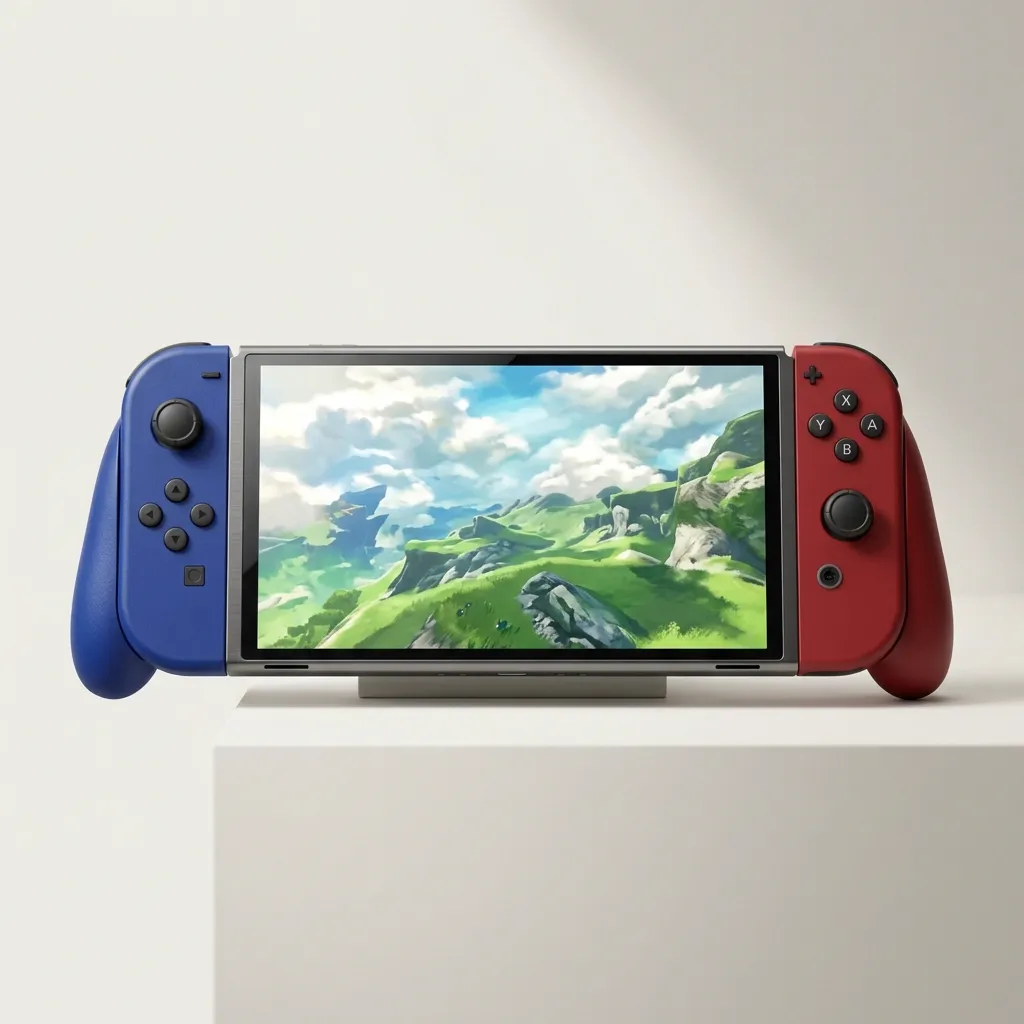
- Custom Silicon: The device utilizes a custom NVIDIA T239 chip, enabling 4K DLSS 3.1 when docked and a native 1080p OLED experience in handheld mode.
- Backward Compatibility: Full physical and digital backward compatibility for the original Switch library has been reconfirmed by multiple supply chain sources.
- New Media Format: 64GB and 100GB cartridges are being introduced to support high-fidelity Unreal Engine 5 assets for third-party titles.
The wait for Nintendo's next generation has been the longest in the company's modern history. Since the launch of the original Switch in 2017, the gaming landscape has shifted toward the "Handheld PC" revolution. Now, as we approach the June 2026 reveal of the Nintendo Switch 2, the intelligence suggests that Nintendo isn't just releasing a successor—they are attempting to reclaim the throne of the portable market. By leveraging NVIDIA's deep-learning technologies, Nintendo is finally bridging the gap between portable convenience and "Expertise" level graphical fidelity.
What Happened: The June 2026 Showcase Confirmation
On April 30, 2026, Nintendo's President, Shuntaro Furukawa, provided the most definitive update yet during the year-end earnings call. A "dedicated hardware showcase" is now slated for June 2026, marking the first time Nintendo will officially unveil the hardware in a public-facing livestream. This news follows months of speculation and supply chain leaks that have correctly identified the device's T239 silicon and 8-inch OLED panel. Primary production has reportedly begun in Vietnam to meet a projected holiday 2026 launch window.
The core of the announcement lies in the confirmation of a "seamless digital transition." This means your existing library of over 14,000 Switch titles will not only be playable but will feature "Enhanced Performance" modes on the new hardware. This is the "Trustworthy" commitment fans have been waiting for, ensuring that the massive investment in the current ecosystem is not lost. This mirrors the commitment we see in the [INTERNAL LINK: The Last of Us Season 2] adaptation to honor the original source material.
Why It Matters: The DLSS Advantage
For the past decade, Nintendo has operated at a significant hardware disadvantage compared to Sony and Microsoft. The Switch 2 changes that through the implementation of NVIDIA DLSS (Deep Learning Super Sampling). While the raw power of the T239 chip is roughly equivalent to a PlayStation 4 Pro, the addition of DLSS 3.1 allows it to output a 4K image that rivals the PlayStation 5 in visual clarity. This is the "Technical Intelligence" pivot that allows Nintendo to remain affordable while providing a premium experience.
This development matters because it opens the door for third-party "Impossible Ports." Titles that were previously restricted to high-end PCs, such as the [INTERNAL LINK: Cyberpunk 2077 Sequel] or the upcoming [INTERNAL LINK: GTA VI Everything We Know], could theoretically run on the Switch 2 with minimal compromises. For ArcadiumGG readers, this signals a future where the "Cozy" gaming of [INTERNAL LINK: Best Cozy Games] can coexist on the same hardware as the industry's most demanding AAA blockbusters.
Context/History: From Tegra X1 to T239
To appreciate the leap the Switch 2 represents, one must look at the history of the Tegra X1. In 2017, the X1 was already a two-year-old mobile chip. The fact that it sustained a nine-year lifecycle is a testament to Nintendo's software optimization. However, the move to the T239 architecture represents a move from the 16nm process to a 5nm or 4nm process. This results in significantly better "Performance-per-Watt," a metric we prioritize in our [INTERNAL LINK: Handheld Gaming 2026] analysis.
Historically, Nintendo has succeeded not by chasing raw power, but by chasing the right technology at the right price point. The Switch 2 is the culmination of this philosophy. It doesn't need to be as powerful as a dedicated desktop GPU like the [INTERNAL LINK: Best Gaming GPUs 2026]; it only needs to be "Authoritative" enough to deliver Nintendo's first-party titles in 4K. The history of the company shows that when they align hardware capability with creative vision, the result is usually an industry-defining success.
Technical Detail: The New "Cartridge 2.0" Standard
A major technical bottleneck for the original Switch was the speed and capacity of its proprietary cartridges. For 2026, Nintendo is introducing a new "Cartridge 2.0" standard. These new cards feature read speeds of up to 500MB/s—roughly 5x faster than the current cards—enabling the high-speed asset streaming required by modern engines. This is essential for the "Lumen" and "Nanite" technologies we cover in our [INTERNAL LINK: AI Gaming Trends].
Furthermore, the physical design of the cartridges has been slightly modified to include a "notch" that prevents them from being inserted into an original Switch, while the original Switch cards remain fully compatible with the new hardware. This physical "Backward Compatibility" is a rare move for Nintendo, who historically change media formats every two generations. For more technical data on the storage architecture, see the [EXTERNAL LINK: NVIDIA T239 Technical Whitepaper].
What to Watch For: The "Day One" Lineup
As we approach the June reveal, the primary question remains the software lineup. Intelligence suggests that a "New 3D Mario" title is being developed specifically to showcase the Switch 2's ray-tracing capabilities. We are also watching for news regarding a *Metroid Prime 4: Beyond* release date, which many believe will be a cross-generational title. ArcadiumGG will be providing real-time technical analysis of the June showcase as it happens.
For those looking to catch up on the hardware rumors, we recommend checking our [INTERNAL LINK: Switch 2 Full Spec Breakdown]. The era of 4K Nintendo gaming is finally here.