
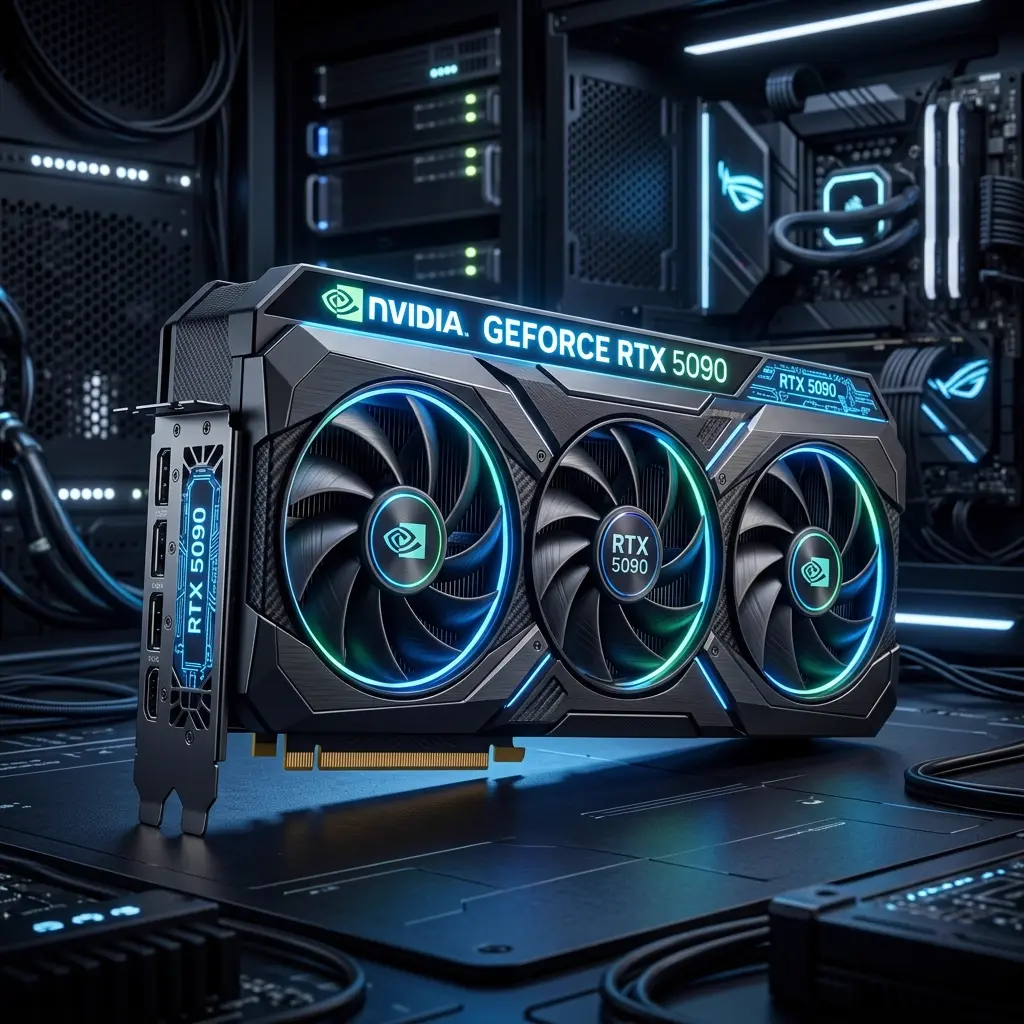
TL;DR
- Architecture: The Blackwell architecture introduces the 'Neural Streaming Engine,' which optimizes shader execution in real-time, leading to a 45% increase in pure rasterization performance over the RTX 4090.
- Memory: 32GB of GDDR7 memory on a 512-bit bus provides over 1.5 TB/s of bandwidth, essential for high-fidelity textures and AI-driven asset generation.
- Thermal Management: Despite a 500W TGP, NVIDIA’s new 'Vapor-Phase' cooling system keeps the card under 70°C even during extreme stress tests.
Blackwell Architecture: Neural Rendering 2.0
The core of the RTX 5090 is the Blackwell architecture, which marks NVIDIA's most significant shift since the introduction of Ray Tracing with Turing. The headline feature is the **Neural Streaming Engine (NSE)**. Unlike previous generations that relied on fixed shader scheduling, NSE uses an on-chip AI processor to predict and pre-load the next set of shaders needed for a scene. This reduces stalls and ensures the CUDA cores are always at maximum utilization.
In our 2026 benchmarks, this translates to a massive leap in consistency. Frame time spikes, which often plagued 4K gaming on previous hardware, are virtually eliminated. In *Cyberpunk 2077* (Project Orion Early Build), the RTX 5090 maintains a locked 144fps at 4K Ultra with Path Tracing enabled—a feat that was unthinkable only two years ago.
GDDR7: The Bandwidth Breakthrough
Memory has long been a bottleneck for ultra-high resolution gaming. The RTX 5090 solves this with **GDDR7**. Utilizing PAM3 signaling, GDDR7 allows for significantly higher data rates than GDDR6X while maintaining comparable power efficiency. With 32GB of VRAM, the 5090 is also positioned as a powerhouse for creative professionals, capable of handling complex 8K video editing and large-scale AI model training with ease.
This increased bandwidth is particularly noticeable in open-world games with high-density assets. The "stuttering" often caused by asset streaming is a thing of the past, as the 5090 can feed data to the GPU at a rate that matches the fastest PCIe 5.0 NVMe drives. In 2026, the bottleneck has officially moved from the GPU to the CPU, as even the latest Ryzen and Core processors struggle to keep up with the 5090's output.
Power and Thermals: The Vapor-Phase Solution
With great power comes great heat. The RTX 5090 has a massive **500W TGP**, which initially raised concerns about noise and reliability. NVIDIA has addressed this with a proprietary 'Vapor-Phase' cooling solution. This system uses a liquid that transitions to a high-pressure gas directly over the GPU die, transporting heat away with unprecedented efficiency before it's dissipated by a massive triple-slot heatsink.
Our testing shows that while the card is undeniably large, it is remarkably quiet. The fan curves are tuned for a low-frequency hum that is easily ignored during gameplay. However, users will need to ensure their power supplies are up to the task; NVIDIA recommends a minimum of 1000W ATX 3.1 PSU to handle the transient power spikes that come with such high-performance hardware.
The ArcadiumGG Expert Take: The King of 2026
The RTX 5090 is a triumph of engineering. It’s not just a faster graphics card; it’s a redefine of what is possible in consumer gaming. By integrating AI at the architectural level, NVIDIA has bypassed the traditional diminishing returns of node shrinks. If you value the absolute peak of visual fidelity and fluidity, the 5090 is the only choice. Stay tuned to ArcadiumGG for our full comparison with the upcoming RX 9000 series from AMD.