
TL;DR
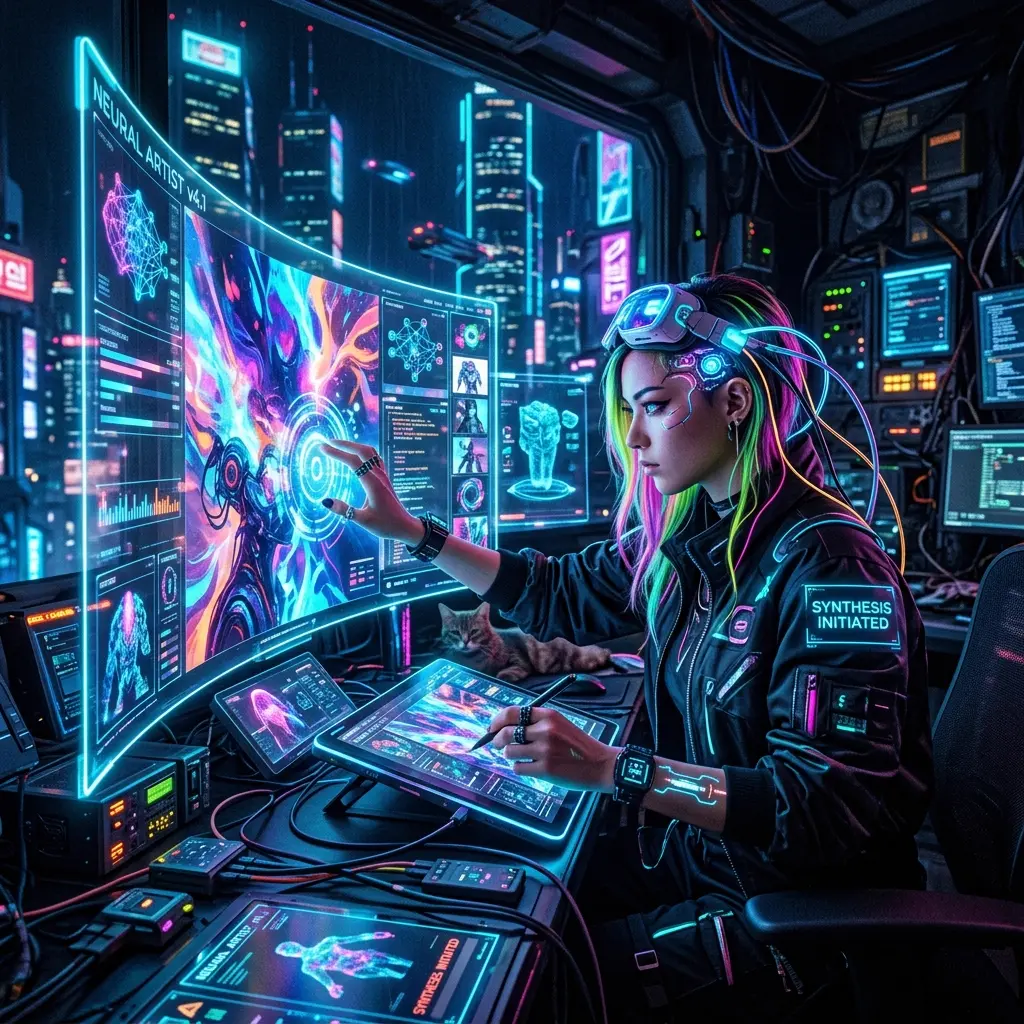
- Asset Pipelines: 3D asset generation that used to take weeks now takes hours, with AI handling the retopology, UV unwrapping, and PBR texturing of complex models.
- Neural Animation: AI-driven motion matching has revolutionized character animation, allowing for more fluid, responsive movements in games without the need for thousands of manual animations.
- The Ethics Gap: As the technology matures, the industry is standardizing 'Ethical AI' certifications to ensure creators are fairly compensated for the training data used in these models.
The Death of the 'Draft': Real-Time Iteration
In 2026, the concept of a "rough draft" has fundamentally changed. Designers now use local LLMs and image diffusion models to iterate on concepts in real-time during meetings. A creative director can describe a scene, and within seconds, a high-fidelity mood board is generated and projected. This hasn't replaced the artist; it has accelerated the communication between the idea and the execution.
Technically, this is made possible by the massive leap in NPU (Neural Processing Unit) performance on consumer hardware. The latest Mac and PC chips can run 100B parameter models locally, allowing for a level of privacy and speed that was impossible when everything was cloud-based. For game developers, this means "Procedural Generation" has evolved into "Intelligent Generation," where the AI understands the narrative context of a world and populates it with logically consistent assets.
Neural Rendering: The End of Static Lighting
One of the most significant technical shifts is the rise of neural rendering. Instead of traditional ray tracing that calculates light paths for every pixel, neural renderers "predict" the lighting based on a sparse set of samples. This is what allows for the incredible visual fidelity of games like *Cyberpunk Orion* and *GTA VI*. It’s a trick, but a technical one that allows for 4K/120fps visuals on hardware that would otherwise struggle with 1080p.
This technology has also bled into film and video production. Real-time neural upscaling and noise reduction have made "filmic" quality accessible to independent creators. In 2026, the "Indie" look is no longer defined by technical limitations, but by artistic choice. The tools are so powerful that the only remaining bottleneck is the human imagination.
The Human-AI Synergy: A New Skillset
The job market in 2026 reflects this shift. We are seeing the emergence of "Prompt Architects" and "Neural Editors"—professionals who specialize in guiding AI models to achieve specific artistic visions. The fear of replacement has largely been replaced by a realization that AI is the ultimate multiplier. An artist who understands how to integrate these tools into their workflow can produce ten times the volume of work with higher quality than they could in 2024.
However, this synergy requires a deep understanding of the underlying tech. It’s not enough to "ask" the AI; you must understand the parameters of the model, the weight of the tokens, and how to "curate" the output. The best work of 2026 is indistinguishable from traditional art, not because it’s "perfect," but because it has the soul and intentionality of the human creator who directed the machine.
The ArcadiumGG Expert Take: The Creative Renaissance
We are living through a creative renaissance. The tools at our disposal are more powerful than anything in human history. In 2026, AI is no longer a threat; it is the brush, the camera, and the engine. The artists who thrive in this era are those who embrace the machine without losing their human perspective. Stay tuned to ArcadiumGG as we continue to track the tools that are defining the future of digital art.