
TL;DR
- Quantum Cloud: Major publishers like Microsoft and Sony are testing cloud-based quantum processors to handle the complex physics and AI of MMOs with millions of concurrent actors.
- Pathfinding: Quantum algorithms can solve pathfinding for millions of NPCs simultaneously, allowing for truly 'living' cities that don't rely on scripted loops.
- Cryptography: The first 'Post-Quantum' anti-cheat systems are being deployed to protect the integrity of 2026's largest esports titles.
Beyond the Bit: The Qubit Revolution
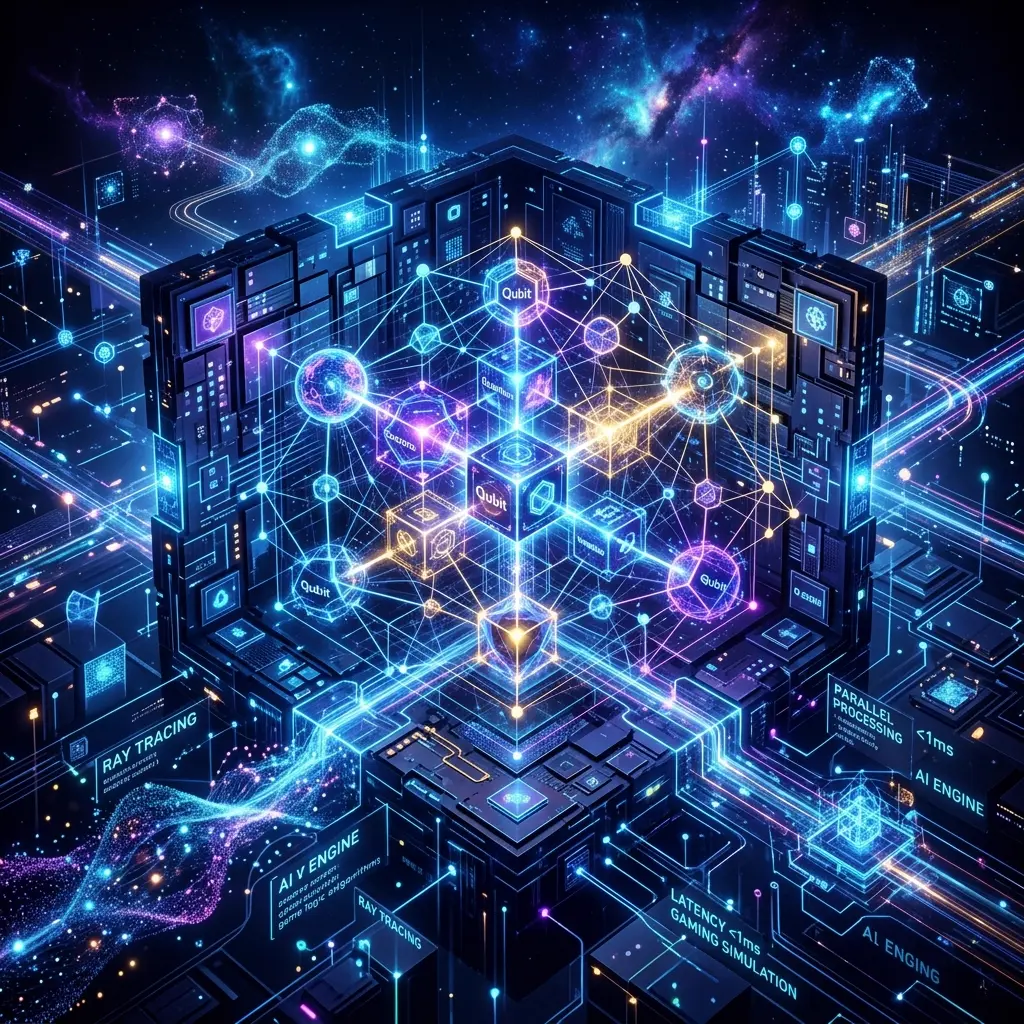
Traditional computers use bits (0 or 1). Quantum computers use qubits, which can exist in a superposition of both states. In the context of gaming, this means the ability to process massive amounts of parallel data that would choke even a cluster of RTX 5090s. In 2026, we are seeing the first practical applications of this in **Quantum-Assisted Cloud Gaming**. While the local hardware still does the final frame output, the complex "world state" is managed by a quantum processor.
One of the primary beneficiaries is **Procedural Content Generation**. Instead of a set of rules that "build" a world, a quantum algorithm can simulate the entire geological and biological history of a planet in real-time. This results in worlds that feel truly unique and detailed down to the molecular level. We’ve seen early demos of this in the "Nebula Engine," where every grain of sand on a desert planet is a unique, persistent object.
True Intelligent NPCs: The Complexity Solve
The "Holy Grail" of gaming has always been NPCs that feel human. Traditional AI is limited by decision trees. Quantum AI, however, can simulate thousands of potential outcomes for a single character's life in a fraction of a second. This allows for NPCs with true "Agency"—they don't just react to the player; they have their own goals, relationships, and long-term memories that evolve based on the quantum world state.
In 2026, this technology is being tested in the first "Living MMOs," where the world continues to change even when no players are present. If a player destroys a bridge, the quantum engine calculates the economic and social ripple effects throughout the entire game world, updating the lives of thousands of NPCs accordingly. This level of persistent complexity is only possible with the parallel processing power of quantum logic.
Post-Quantum Security: Protecting the Play
As quantum computing advances, so does the threat to traditional encryption. The gaming industry is leading the charge in **Post-Quantum Cryptography**. In 2026, the largest esports leagues have moved to quantum-resistant anti-cheat protocols. These systems ensure that no matter how powerful a cheater’s hardware becomes, the integrity of the match is protected by the laws of quantum physics.
This "Quantum Hardening" is also being applied to digital ownership. The next generation of digital assets (non-fungible but technically improved) are secured by quantum-locked contracts, ensuring that your rare items are truly unique and impossible to duplicate through traditional hacking methods. It’s a new era of digital trust, built on the foundations of subatomic particles.
The ArcadiumGG Expert Take: The Final Frontier
Quantum gaming is the final frontier of digital entertainment. While we are still in the "Early Access" phase of the technology, the implications for 2026 and beyond are staggering. We are moving from "Games" to "Simulated Realities," where the only limit is the number of qubits we can keep stable. Stay tuned to ArcadiumGG as we track the first quantum-powered titles scheduled for 2027. The future isn't just binary; it’s superposed.